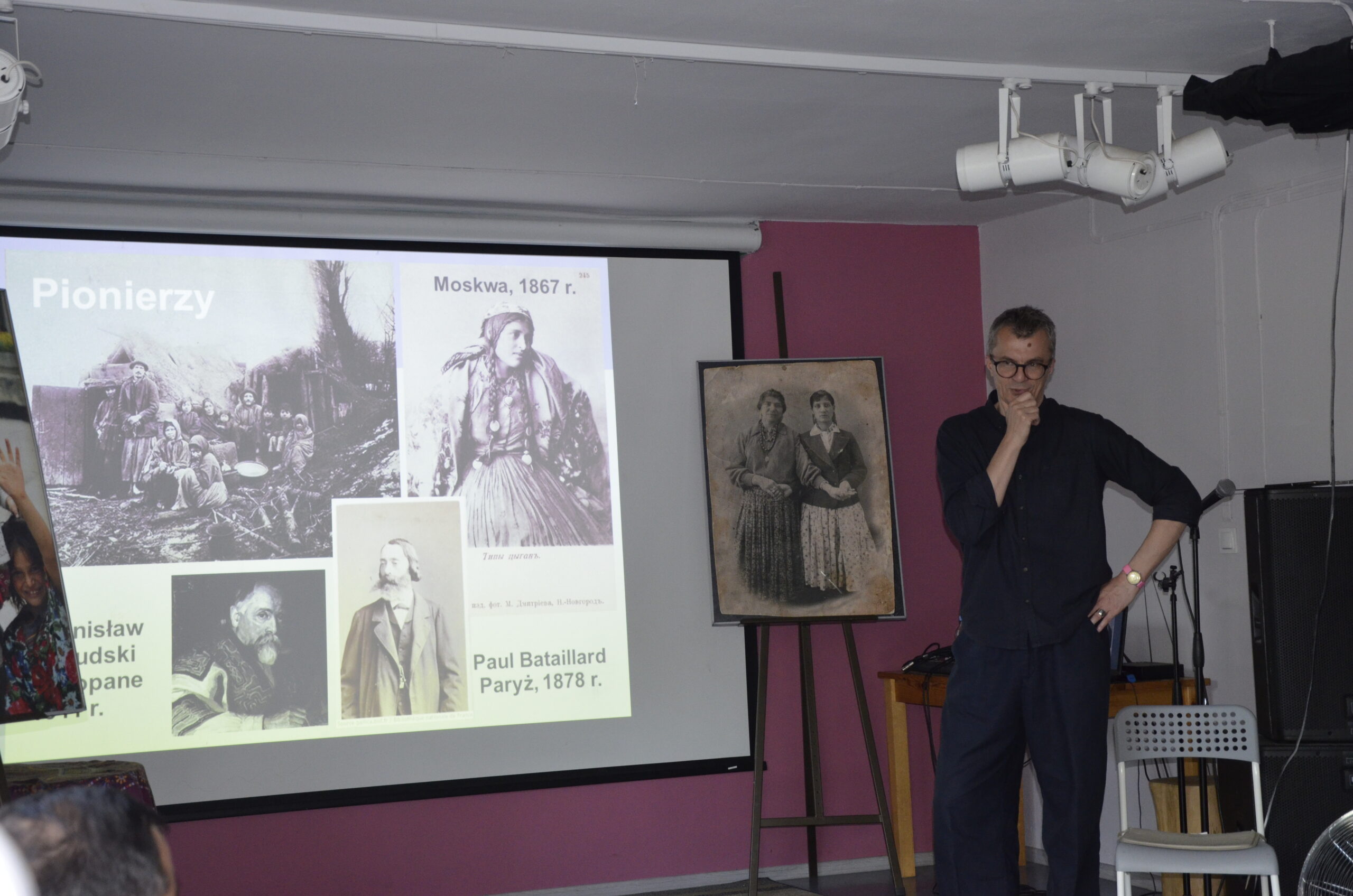
Andrzej Grzymała-Kazłowski, photo: Ada Szulc
Bareforytka Roma, Warsaw’s Roma – how do you see Warsaw’s Roma community? What are its characteristic features that make it different from other Polish Roma communities?
Warsaw Roma are, first of all, a very diverse community. It has its peculiarities, differences, but in public almost unnoticeable. In other cities there are Roma organisations, social and cultural projects. In Warsaw there is practically no bigger activity, except for Praga Południe – Grochów, where a Roma assistant has been working for many years and where various activities, rather positivistic and educational, are carried out on the basis of the Praga Południe Social Welfare Centre. And Ursus, where a community centre associated with the local Social Welfare Center operates. Maybe there is a little lack of such a cultural, artistic dimension here in Warsaw, but it is hard to be offended by this, if there is no such potential or interest, it is difficult to do something by force.
There are several different communities in Warsaw. The largest one, the Polish Roma, who were settled in the 1950s, 1960s. And smaller groups of other former travellers – the Kalderash and the Lovara. In the case of the Lovara, there was a very interesting family who had already emigrated from Warsaw to a large extent – the Czokeszti Lovara, including the Michaj family. Burano (known as Michaj Burano), a very popular singer of the big-beat era, was associated with Warsaw. The Michaj family was active artistically, for instance, to mention their band “Roma”. But unfortunately they have moved away, to other cities, but above all abroad, to Sweden, Germany. Burano lives in the United States.
You can meet the Warsaw Lovara in Gocławek, Ursus, Rakowiec and also near Warsaw in Marki. They live their lives and are not particularly noticeable.
Among the Polish Roma, we have Andrzej Pawłowski, the best-known musician, leader of the “Rat Romano” band. He made a name for himself by (among other things) collaborating with Michał Lorenz on the movie “Bandyta”. He wrote the Roma lyrics for Lorenz’s compositions. Jędrek’s daughter also sang a beautiful vocal. Andrzej is popular with viewers of TV talent shows, where he has also been successful.
The Warsaw Roma live their lives, they have their affairs, they work and try to survive. It’s quite a big community, although we don’t know how big, 500 people or maybe closer to a thousand. For the most part, they function in traditional structures specific to their groups of Polish Roma, Lovara, Kalderash. The latter two have been intermixed for a long time, due to their cultural and dialectal proximity, many families are intergroup families. These communities are beginning to be homogeneous to some extent, although they still remain distinct from the Polish Roma. Warsaw’s Roma are a very interesting community, but hardly known or visible in action, especially compared to other cities.
Since when have the Roma been in Warsaw? What is Warsaw’s Roma history?
We do not know exactly. Most likely they came to Warsaw, as they did to other cities in the Kingdom of Poland, that is, probably the end of the 15th century and the 16th century. Warsaw was becoming an increasingly large city, a market, trade and cultural centre, so the Roma, already present in large numbers on Polish lands, must certainly have appeared here. We also have numerous traces of their presence in the city books, although many documents were unfortunately burnt by the German occupiers during World War II. But some of the earliest references to Roma in Warsaw speak of courtiers of the Waza dynasty. Grants of authority to the so-called 'Elders over the Gypsies’ have been preserved, including Jan Kazimierz’s grant to Matiasz Korolewicz, son of Janczy – the previous supervisor by the order of Władysław IV. We know that this Janczy was a bagpiper, a musician at the court of the Waza dynasty, probably a newcomer from Hungary or with Hungarian roots – the name „Janczy” may indicate this.
In modern times, Edward Dębicki, a great musician, composer and social activist from Gorzów Wielkopolski, recalled that there were documents in his family confirming that the band of his ancestors played at the court of Marysieńka Sobieska.
Then there is the whole history of Warsaw city life rather related to temporary visits than bourgeois life. Unfortunately, these are mainly persecutions, recorded in documents from circuses, where Roma are mentioned as being locked up, prosecuted for having led a nomadic, „loose”, „vagrant” lifestyle.
We have a relatively large amount, a rash of information and reports from the second half of the 19th century, that is, when the so-called migration of Lovara and Kalderash – Roma freed from serfdom on the territory of present-day Romania and Hungary – began. They appeared in and around Warsaw after the January Uprising, when unrest and hostilities ceased. In the Warsaw „Tygodnik Ilustrowany” of 1868, there was printed an engraving and description of the Kalderash’ camp in Saska Kępa. Each year, more and more similar information appeared.
In the 1920s, 1930s, the press of free Poland quite often wrote about various royal reshuffles among the Kalderash, who presented themselves to journalists and the public as kings, chiefs, superiors, presidents of the 'Gypsy’ nation. Of course, this had little to do with the truth – they were at most the superiors of their ancestral groups. However, for the media, especially the more 'revolting’ ones, it was something tasty, sometimes with a fight, sometimes a shootout in the background. One of these kings, Matejasz Kwiek, was even killed by an accidental gunshot. Coronations, abdications, manifestos… the press was fond of quoting it. The apogee was the coronation of Janusz Kwiek in 1937 at Legia Stadium, where both the radio broadcast and foreign media correspondents and photographers were present. We have this event very well documented. Janusz Kwiek was crowned by the protopresbyter of the Orthodox Church. In the place of honour sat government officials, the wife of Prime Minister Składkowski, generals, colonels and the entire Sanacja ruling class watching the spectacle, which was the election of a king, but at the same time a ticketed concert and an attraction in itself.
And the tragic times of the war… In Warsaw the Roma were hiding and were prisoners in the ghetto. Transports of Roma from other ghettos were sent to the Warsaw Ghetto. In his journal, the head of the Warsaw Judenrat, Adam Czerniaków, describes the arrival of a group of Roma from the Łowicz ghetto to the Warsaw ghetto. From the description, it appears that they were Kalderash. The Roma stayed in the Warsaw Ghetto for a shorter rather than longer period of time, and then, like most, ended up in the gas chambers of Treblinka. During the war, the trapping of Roma was continuous, and they were either shot or sent via Pawiak to concentration camps. Jerzy Ficowski cites dozens of places where Roma were exterminated in Warsaw during the Second World War.
Post-war times: the Roma, survivors of the Holocaust, came here, they returned, just like other Varsovians and visitors. They settled here more or less compulsorily. In the 1940s and 1950s, rather voluntarily – for example, the Michaj family, who moved here from Lublin and earlier repatriated from the Soviet Union. But as early as 1964, a brutal forced settlement campaign was launched. A lot of families were settled here, mainly from the Polish Roma group. The picture of the Roma presence in Warsaw is, on the one hand, the result of the post-war settlement action and, on the other hand, of the migration movement. Whoever could, who had foreign connections, left Poland to go abroad. Then came the 1990s and economic hardships, which affected all Poles, including the Roma, and caused them to leave in large numbers for the British Isles, Scandinavia and Germany. The Roma community in Warsaw is far less numerous than it was back in the 1980s. We don’t know exactly what these estimates look like today.
But let’s mention some more details from recent years… We have several murals in Warsaw. One by Krzysztof Gil, a prominent Roma painter – in Grochów at 42 Męcińska Street, from Grochowska Street, near the Wiatraczna Roundabout – is a commemoration of the Roma Holocaust – „Zalikierdo Drom”, or broken road. And at 2 Raszyńska Street, where the primary school from the Bednarska complex is located, in the courtyard on the wall surrounding the football pitch, a series of murals was created by Dariusz Paczkowski, an excellent, well-known artist of Polish Street Art, in collaboration with young people from this school. There we have a gallery of important figures. There is the excellent Roma violinist Kororo Stefan Dymiter, Karol Parno Gierliński – poet, sculptor, Roma activist, Nońcia Alfreda Markowska, heroine of wartime. And Papusza, of course. These places are definitely worth a look.
Where did the idea to create a Museum of Roma Culture in Warsaw come from?
The museum is a bit of a result of my being among the Roma, working with the Roma, where contacts combined with personal interest, history, art, paintings and prints. At first I collected and bought things that I liked, that I wanted to hang on my wall. At a certain point, there were so many of these things that I succumbed a little to collector mania… The collection started to grow, to expand. I started buying things also unrelated to aesthetics, art, and more to historical importance. At a certain point I decided that the collection was large enough, significant enough, to try to organise it into a museum collection. And I went through this process where the Ministry of Culture and National Heritage decided that my collection deserved to be included in the register of private museums. It’s a flying museum, still unfortunately without a permanent exhibition, showing the collection from time to time in exhibitions and on the Web at www.romuzeum.pl. Also on the Facebook profile “Papusza i Muzeum Kultury Romów w Warszawie” (https://www.facebook.com/Papusza1) – although this is more of an information channel, where I inform about contemporary events rather than show the collections, although from time to time, in an appropriate context, fragments of the collection can also be seen.
Interviewed by Ada Szulc from the “Dom Kultury” Foundation.
We would like to thank Magdalena Wychowska for her help in transcribing the interviews.
